Platform
WhatsApp Business, owner side
Product Design
How a home baker works with an AI assistant on WhatsApp: what it answers alone, where it stops and waits for her, and what happens when it gets one wrong.

Letting AI speak for a home baker, without letting it speak for her kitchen.
I designed how a home baker works with an AI assistant on WhatsApp: what it answers alone, where it stops and waits for her, and what happens when it gets one wrong.
WhatsApp Business, owner side
Clickable prototype. Not yet user-tested.
I helped a solo home baker hand her WhatsApp replies to an assistant by making every reply that could commit her kitchen wait for her.
owner interviews
customer message types
simulated chats
things it never does without her
usability sessions so far
Small business owners who take orders on WhatsApp lose orders to late or missed replies, but are afraid that an AI replying in their name could promise what their kitchen cannot deliver.
How might we enable a small business owner to let AI manage customer conversations, without losing control of her business or her customers' trust?
"Hi aunty, do you have the eggless chocolate cake today?" Answers from this week's list, asks which chocolate and when. Notes it as not booked.
"I need 40 cupcakes for an office party on Saturday. What's the price?" Takes flavours, pickup and time. Won't book Saturday or send a final price until the owner checks.
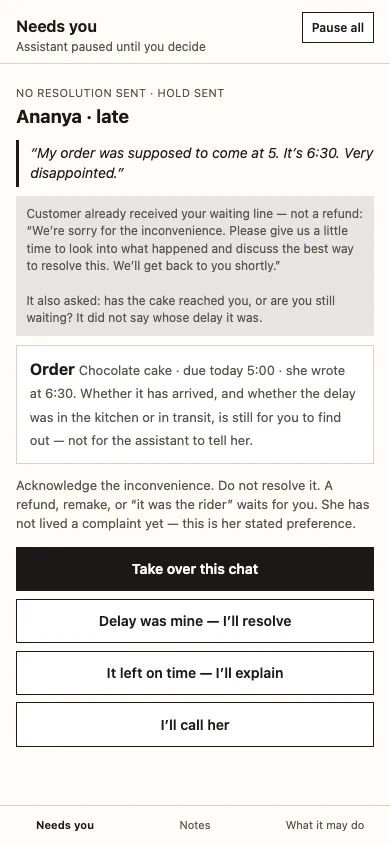
"My order was supposed to come at 5. It's 6:30. Very disappointed." Sends the owner's own apology line. No refund, no blame. She takes it from there.
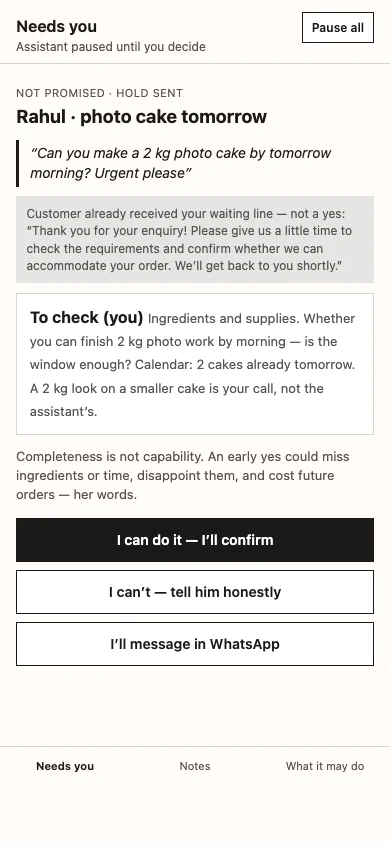
"Can you make a 2 kg photo cake by tomorrow morning? Urgent please" Sends only her waiting line. She decides if she can make it.
A helpful-sounding reply can cost her a cake, a customer or a Saturday.
The owner runs a home bakery from her kitchen. Nearly every order arrives on WhatsApp, at night, during school pickup, or while she is mid-bake. Some messages go unanswered, some get late replies, and orders are lost. An assistant could fix that. She sees the value, and she hesitates, because her name is on every reply.
The question I was given: how might we enable a small business owner to let AI manage customer conversations, without losing control of her business or her customers' trust? Most AI tools are built for the customer's side of the chat. This case is about the owner's side, including what happens when the assistant is wrong.
Two bakers, two different answers to "would you let it speak?"
I interviewed two real home bakers and kept them apart. They agree on where the risk sits. They disagree on whether an assistant should speak at all.
"Thank you for your enquiry! Please give us a little time to check the requirements and confirm whether we can accommodate your order. We'll get back to you shortly."
CrumbLust, the holding message she wrote herself for an urgent custom order
"We're sorry for the inconvenience. Please give us a little time to look into what happened and discuss the best way to resolve this. We'll get back to you shortly."
CrumbLust, the holding message she wrote herself for a complaint
Both interviews are written accounts supplied by me, not recordings, so wording is each baker's stated account. CrumbLust had not yet lived a complaint, so her complaint answers are preferences, not incidents. Neither baker is the persona below, and I did not average them into one person.
Completeness is not capability.
Both bakers had refused an order after every detail was filled in: an intricate small bento cake, and 2 kg detail squeezed onto 0.5 kg. The form was complete. The cake was not something they could stand behind.
So the trust risk is not that an assistant might chat. It is that a reply can commit her kitchen and her name, in a tone that sounds finished. The line to design is between answering and promising.
Three key features that let the assistant do the talking while the owner keeps control of her kitchen.
Each one answers a problem the interviews made clear.
Problem from the interviews: urgent orders need at least 5 hours of notice, and last-minute orders are difficult to carry out.
Problem from the interviews: the same questions about flavours, fillings and availability repeat all day, while custom designs need her judgement.
Problem from the interviews: a customer can ask many questions and never confirm, and a detailed order can be dropped after the work is done.
The owner, whose name is on every reply.
A composite built from the brief and the two interviews. I have not given her an age, income or family details, because nothing I have supports them.
Home baker. Customers call her "aunty". Runs sales, support and orders from a single phone. Orders arrive almost entirely on WhatsApp, often late at night, at school pickup, or mid-bake.
Flavours, fillings, egg or eggless, this week's menu, collecting date, pickup and quantity.
Custom designs, a final price, "you're booked", anything urgent, and any refund, compensation or blame.
What she hands over and keeps is taken from CrumbLust's answers and Megha's practice. It is a design assumption for the owner until tested with her.
Six moments with the assistant, and where trust is won or lost.
I mapped the owner's side of the day, not the customer's. The moments that matter most are the three where the assistant could speak for her and be wrong.
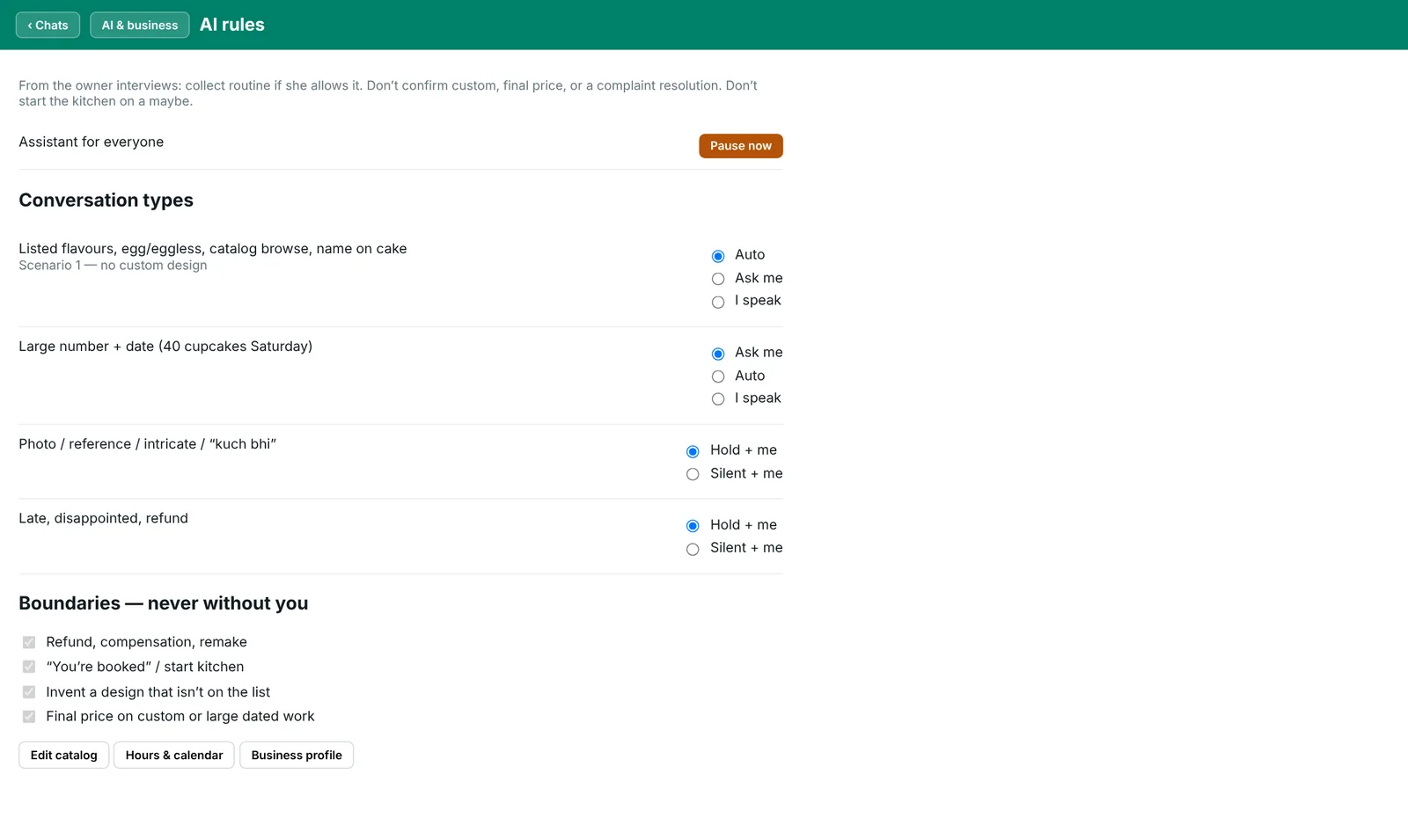
First setup. She is opening AI and business and choosing what it may do alone. Worry: will it say something I cannot stand behind? Design: rules in her split, Auto, Ask me, I speak. Four boundaries locked on. Pause for everyone in the header.
She is icing a cake while routine questions arrive. Worry: is it saying the right thing while I'm not looking? Design: answers from this week's list, collects details, marks the chat AI handled and Not booked. No approval needed.
Ravi, Rahul, Aarav. She sees a Needs you chip and opens a draft that has not been sent. Worry: can I make this by Saturday, with two cakes already booked? Design: customer gets her waiting line. Draft shows Not sent, awaiting you. Approve, Edit or Reject.
Ananya. She is reading a customer who is already unhappy. Worry: will a canned sorry sound like nobody is listening? Design: sends her apology line and one factual question. Tags No resolution. Take over is one tap.
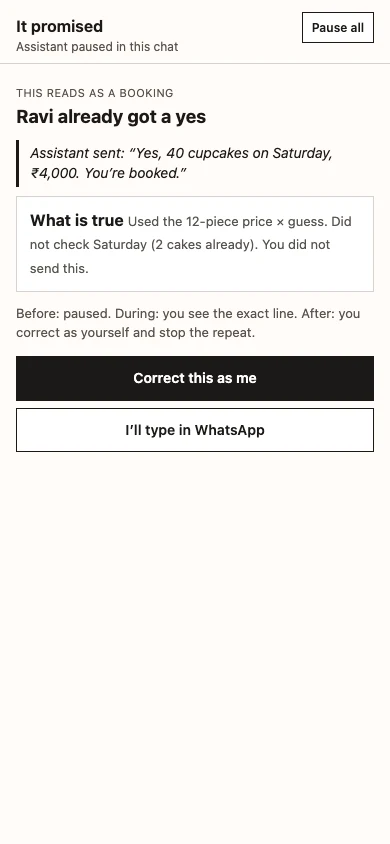
Divya. She finds that a customer holds a yes she never sent. Worry: how bad is it, and what exactly did it say? Design: pauses that chat, quotes the exact send in red, offers three honest correction lines she sends as herself.
She scans the inbox and the activity log after the rush. Worry: did anything go out that I missed? Design: filters for Needs attention and Awaiting approval, status chips on every row, and an activity log.
Today, the pains are that she is hesitant to let it speak for her business, unanswered or late replies lose orders, a complete form looks like a yes, a refund or blame offered too early cannot be taken back, fixing a wrong send means digging through the thread, and activity is invisible unless she rereads every chat. The worry and feeling in this map are my reading of the interviews and the brief, not measured feelings.
Four scenarios, one rule: the owner steps in only where a promise begins.
I split the work into four flows. The first three cover how an order gets from enquiry to confirmed. The fourth covers what happens after.
Goal: the customer explores, picks and confirms on WhatsApp without needing the owner. Prototype: Priya (works) and Aarav (doesn't).
Opens WhatsApp and asks about the bakery, kitchen hygiene and prices.
Shares her story, from-scratch approach, a kitchen photo, designs with price per kg. It says it is the assistant.
Picks a listed design and a simple customisation, such as a name on the cake.
Collects weight, pickup or delivery, time. Summarises with "not started baking, reply yes to confirm".
Customer replies yes. The assistant forwards the order to the owner. Kitchen starts only after she checks the calendar.
The assistant sends her waiting line and does not promise the design. The owner takes the chat when the customer dislikes the list, needs an unlisted option, or the request needs her judgement on feasibility.
Goal: quick orders go through fast, and the owner is clearly alerted when one is confirmed. Prototype: Rahul.
States the advance-order requirement first: please order at least 5 hours ahead. Shows only designs eligible for urgent orders.
The customer chooses a pre-approved design and enters details. The assistant checks the urgent-order conditions and never promises availability on its own. The owner gets a distinct ringing alert with the order details once the urgent order is confirmed.
The assistant connects the customer to the owner to check feasibility. She decides if the cake can be prepared and delivered in the customer's time. Then the assistant can confirm.
A customer turned away on an urgent request assumes quick orders are not possible and does not come back, so the rule is shown up front. The alarm fires only on a confirmed urgent order, not on every enquiry. A normal WhatsApp notification may not ring reliably, so this needs its own notification with permission. The 5-hour window is Megha's rule. The owner sets her own.
Goal: understand the vision, document what was agreed, get an explicit yes. An enquiry is not an order. Prototype: Ravi (draft she approves).
Wants a design or customisation the list does not offer.
Connects them to the owner.
Discusses design, occasion and expectations. Records price, date and details.
Writes the agreed specification as an order summary in the chat, so both sides have the same record.
Reconfirms design, price, delivery schedule and terms. The order is ready to bake only now.
First-time customer: the assistant asks for the owner's advance of ₹100–₹200 and helps with payment, marking it received only after the transaction is verified. Existing customer: The owner follows her usual payment policy, with design, status, date and payment recorded in one place.
Goal: the assistant watches the loose ends so the owner does not carry them in her head. Designed, not in the prototype.
The assistant logs the confirmed order and assigns a slot first-come, first-served.
It watches the delivery window and payment. If a delivery runs late or a payment confirmation is missing, it sends the owner an urgent alert card.
When she marks the order delivered, it sends a short feedback form on WhatsApp and routes the reply to her.
At month end, it compiles orders, sales and feedback into a plain list of pros and cons.
Eggless chocolate today? What's on the list? The assistant answers from this week's menu, asks flavour, date, pickup, and leaves her a note. Nothing waits for the owner. She can ignore it while baking.
40 cupcakes, Saturday. The assistant collects number, flavours, pickup, time and shows her an overview. The owner decides booking Saturday, the final price, the yes.
Photo cake, galaxy glaze. The assistant sends her waiting line only. The owner decides whether she can make it, and every promise about time and design.
Late, disappointed. The assistant sends her apology line and asks one fact: has it arrived? The owner decides refund, remake, compensation, and whose delay it was.
The assistant never says "you're booked". It asks the customer to reply yes first. The kitchen starts only after the customer confirms back.
Four forks that shaped the product.
Each one had a reasonable alternative. Here is what I weighed and what I dropped.She sets rules once, up front. Feels like homework at 1–2 enquiries a week, and fails if a custom request looks complete.
Silence on routine, a clear ask on judgement. Built for hands-in-batter hours. Gets noisy if the list is wrong.
Contains damage after a wrong promise. Interrupts too late to be the whole product.
I shipped B for daily use, with A's defaults and C's repair, because CrumbLust asked for "a combination": independent on basics, her on custom designs and final confirmations. She did not want to approve every reply.
Nothing canned reaches a hurt customer. It was my research bet. She did not ask for it.
Acknowledges them immediately, in her words, and commits to nothing. Might still sound like a bot.
A refund is a commitment only she can make. Blaming the rider before she knows is a guess.
I dropped my own silence idea. She wrote the apology and waiting line herself and ruled out any refund or resolution without her. The risk that a canned sorry feels like not being listened to is still open, and it is the third thing I would test.
Fastest for the customer, but both bakers refused complete orders they could not do.
Her judgement is in, but Megha once baked a negotiated order the client then dropped.
Matches Megha's double confirmation. The draft says "I won't bake until you confirm".
Kitchen work starts after two yeses. This protects her ingredients and her afternoon, and the prototype states it in the details panel of every chat.
The brief is about the owner. Megha rejects intake bots.
She runs everything from one phone, often with floury hands.
Shows "not promised" without rereading, but is a second surface she may never open.
Status chips, filters, approvals and Take over sit where she already works. Real WhatsApp behaviour is mocked.
I first built nine screens as a companion layer, then moved the same ideas into the inbox itself. Customers and Megha already avoid extra apps. The owner should not need a new one either.
Her inbox shows what each chat has promised.
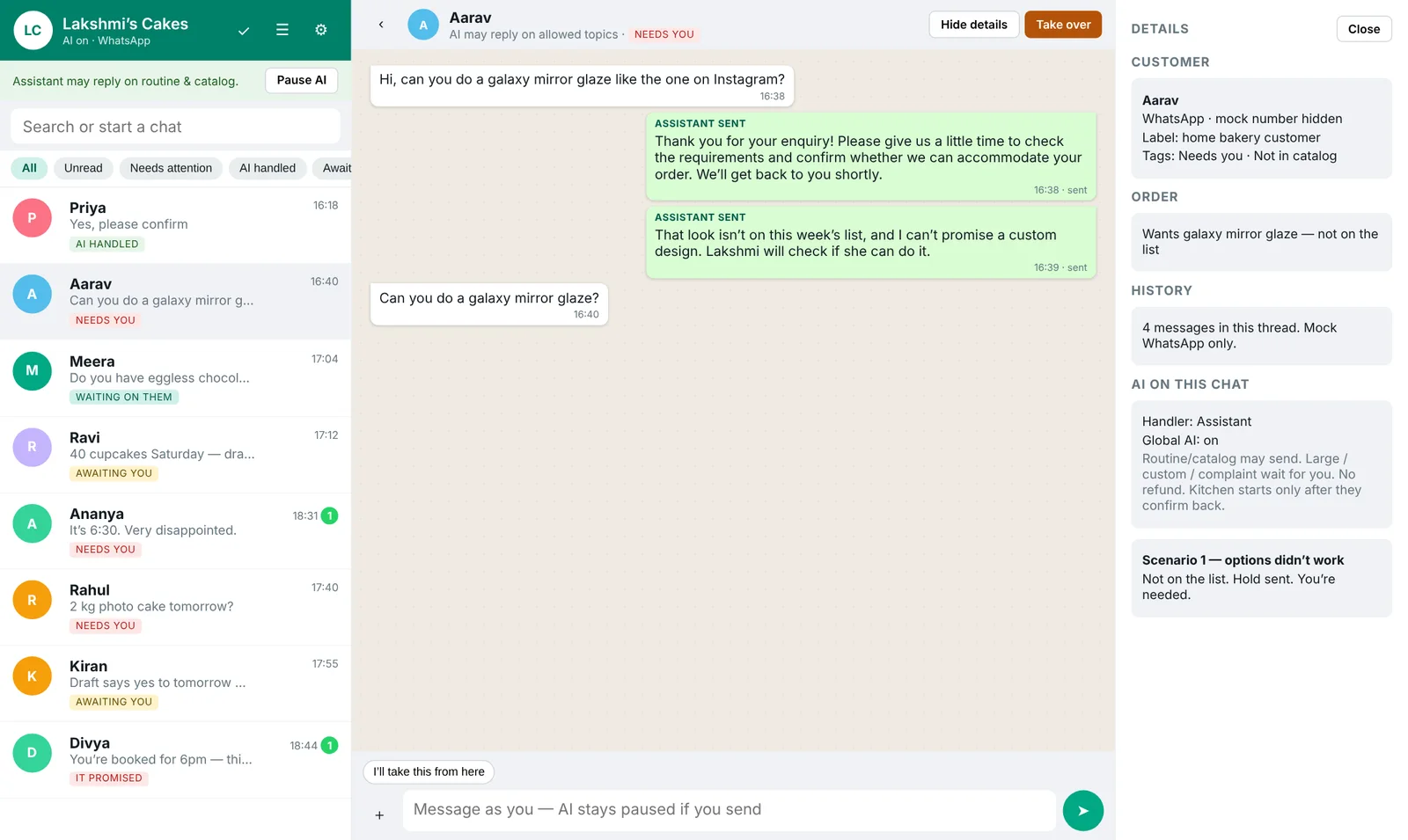
A clickable WhatsApp Business inbox with the assistant switched on. Every thread carries one of a few states, so she can tell at a glance whether something is open, held, booked or already sent in her name. Use "Open the clickable prototype" at the top of this page to try it.
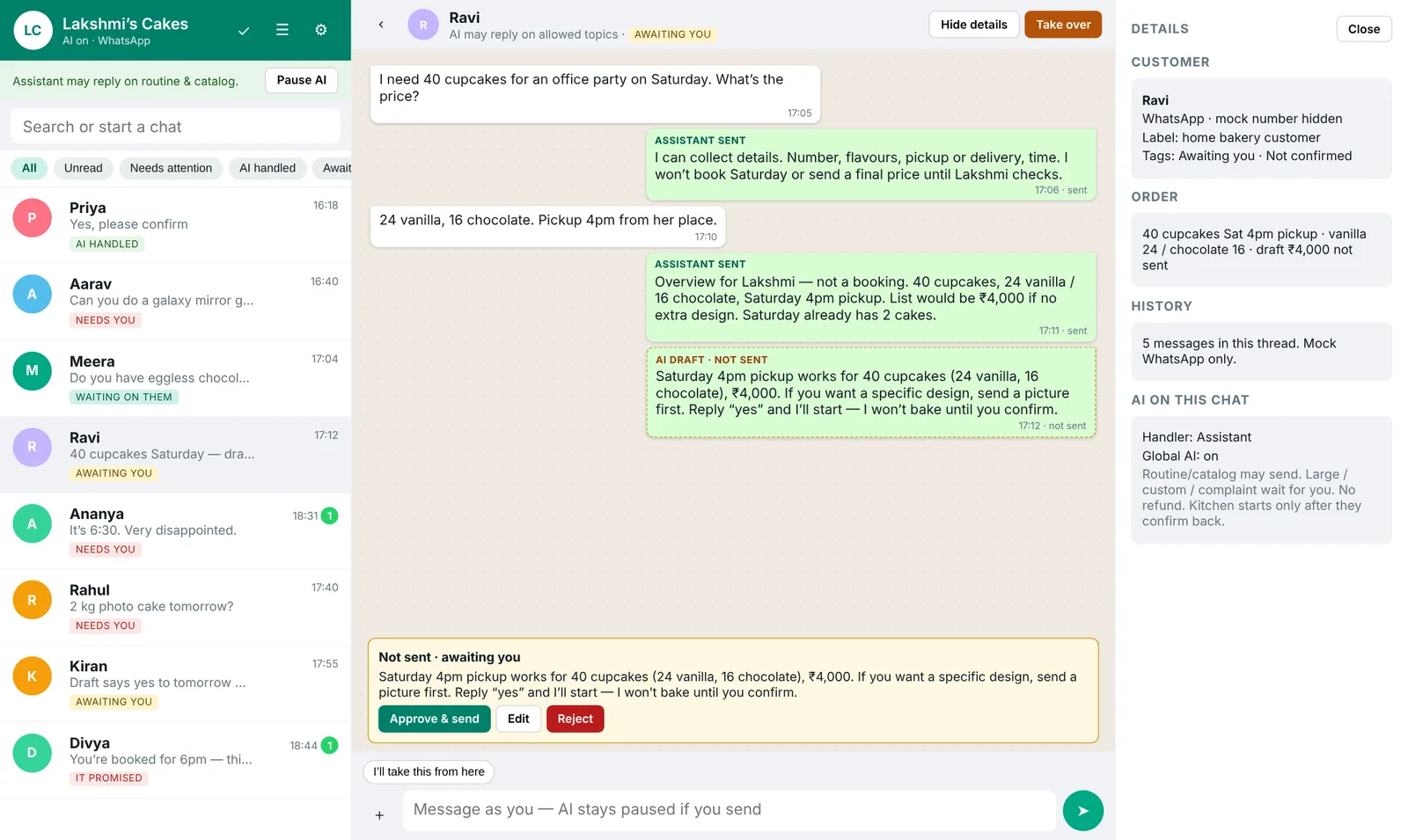
AI handled, Waiting on them, Awaiting you, Needs you, It promised. Filters narrow the list to what needs her.
A dashed bubble and a yellow bar separate a draft from something the customer already read.
Take over pauses the assistant in that chat. If she types, it stays quiet.
The details side shows what the assistant may do here and that the kitchen starts only after the customer confirms back.
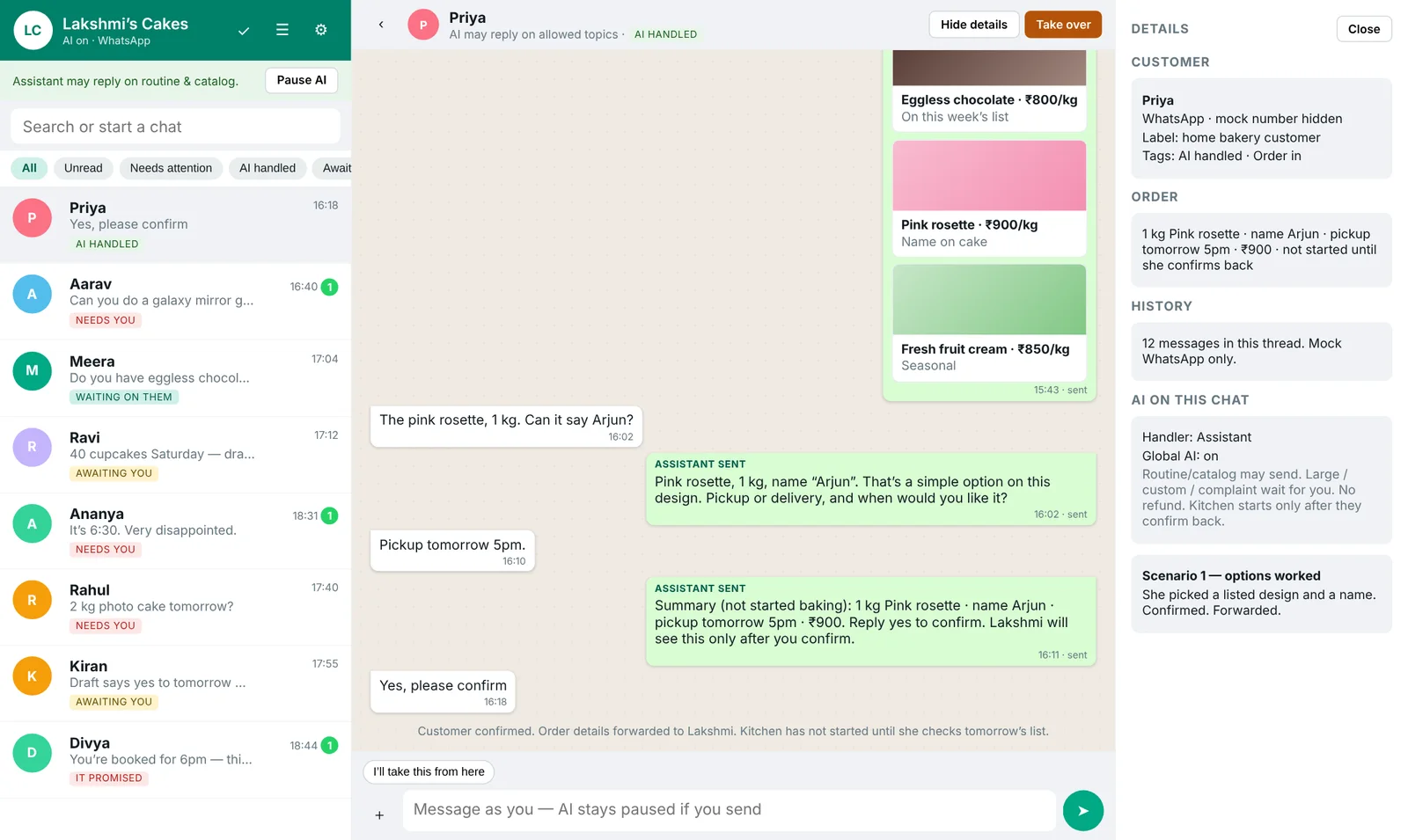
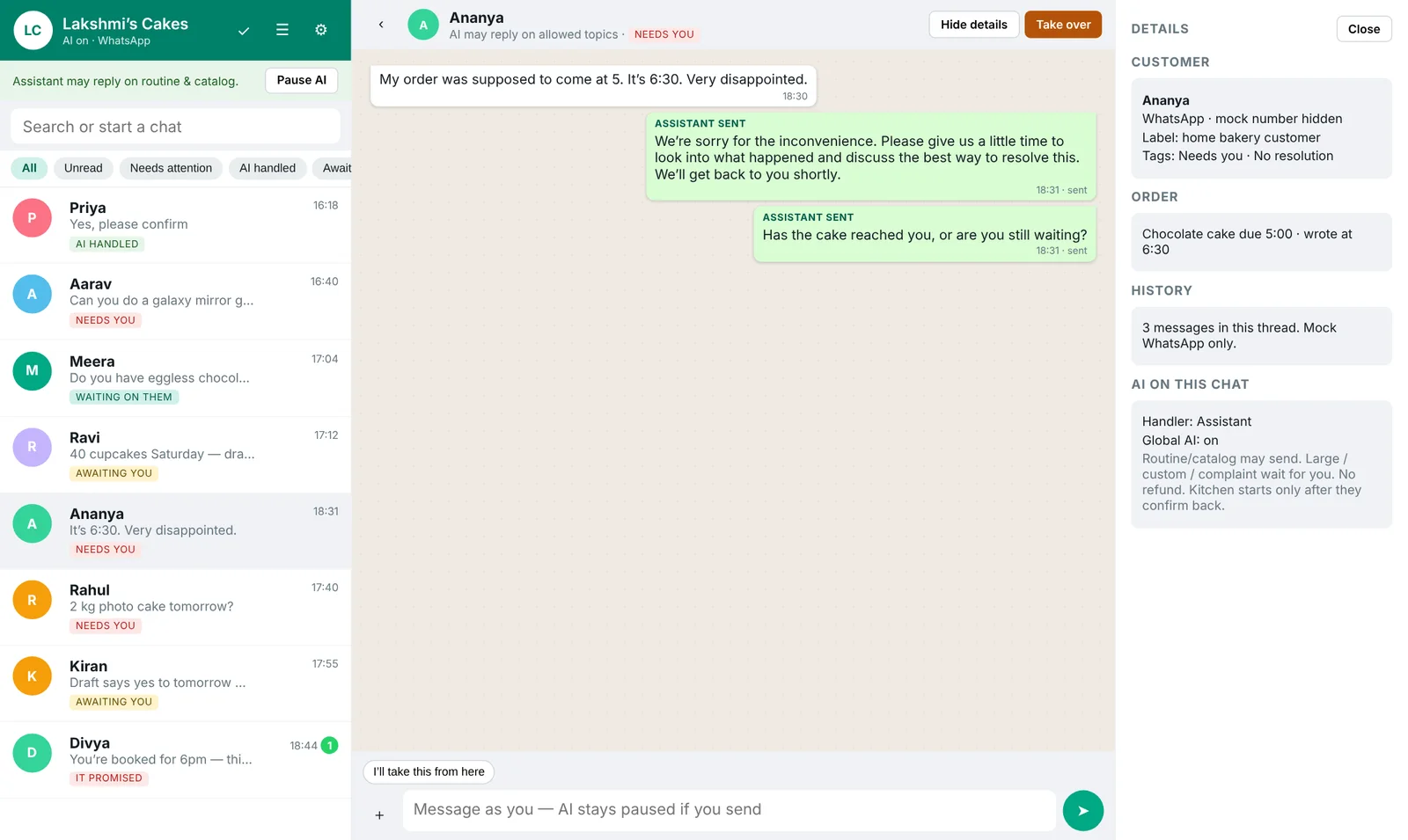
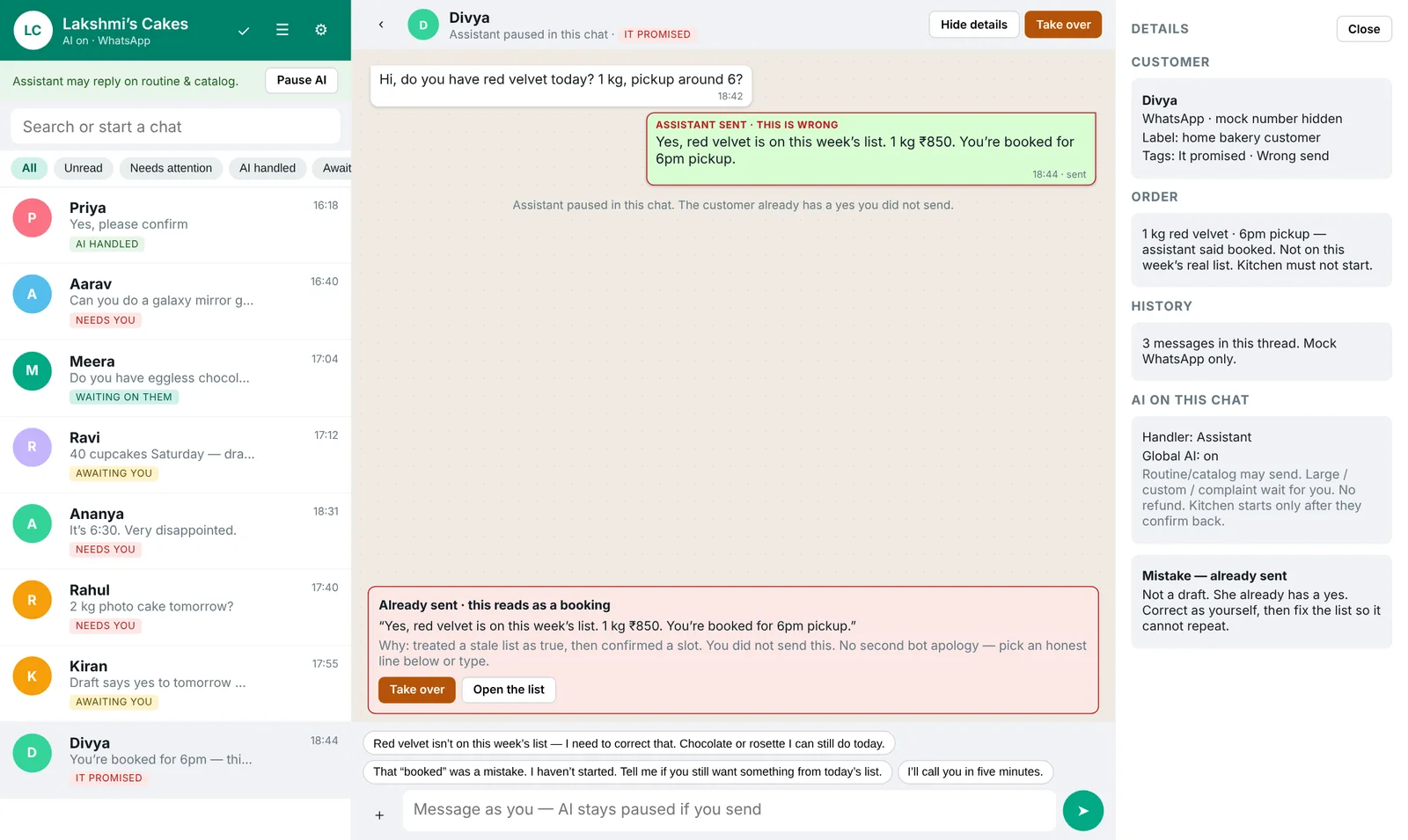
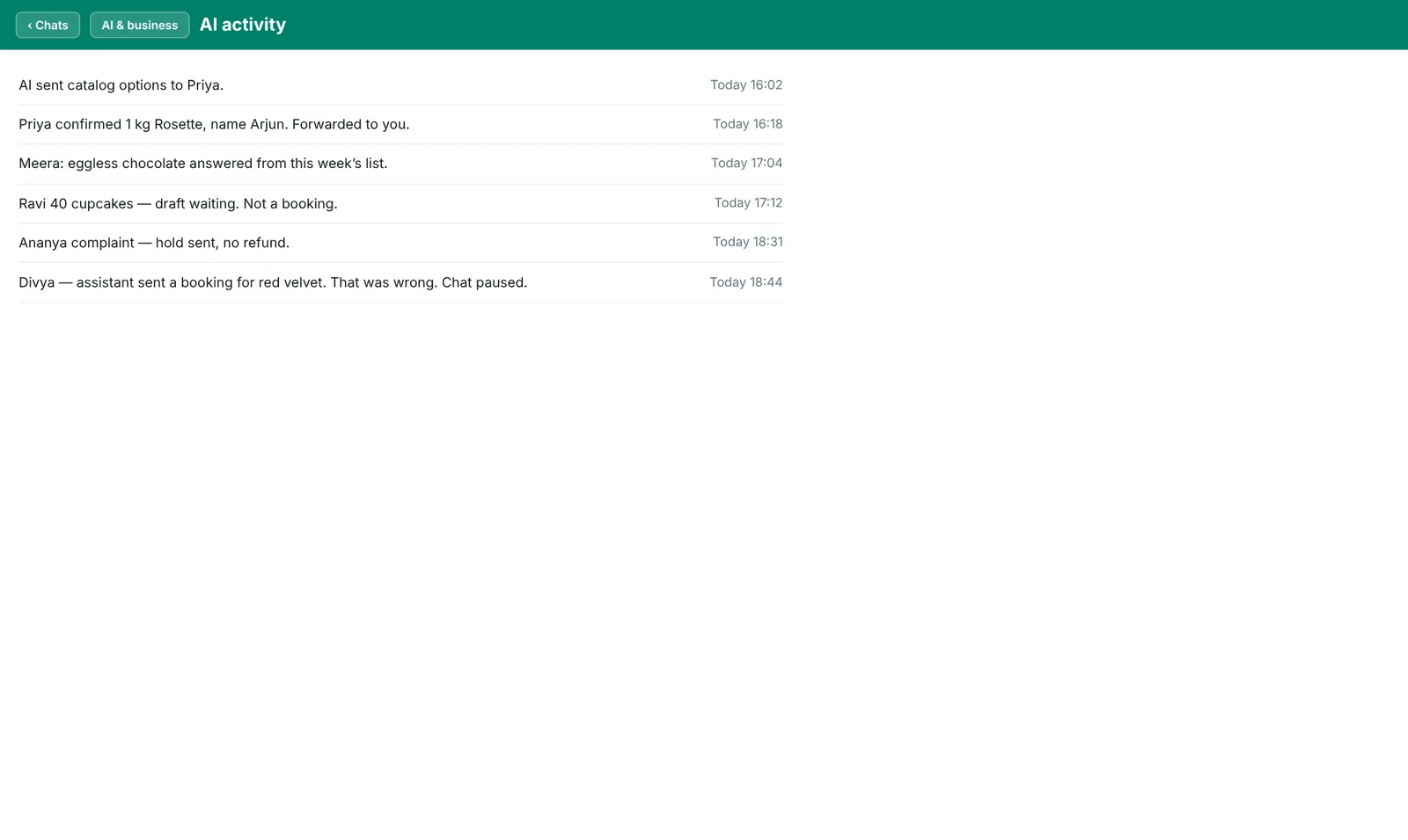
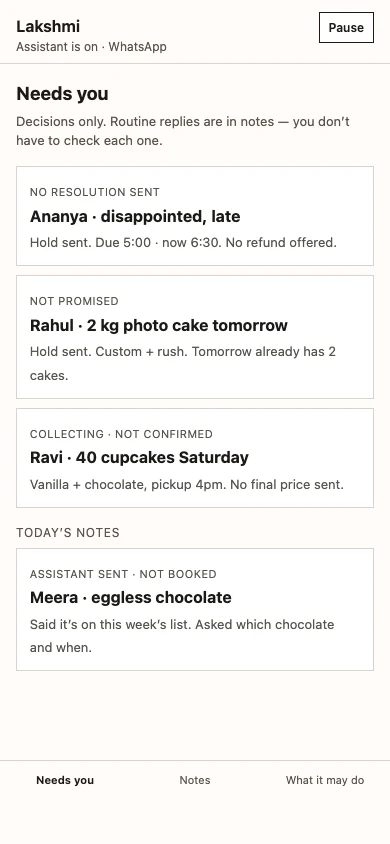
Before moving into the inbox, I built the same logic as a phone-sized layer next to WhatsApp. It is where the Needs you, Not promised and It promised language came from.
The interviews contradicted my first draft.
The brief describes lost orders and missed chats. CrumbLust replies fast in the daytime and has not lost one. Megha is busy and still says no to a bot. I kept the disagreement visible. The default follows the brief and CrumbLust, and Megha's stance is served by Pause and the I speak setting.
I had planned silence on complaints. CrumbLust asked for a short apology and her own waiting line. I switched, and kept the silence idea on the list of things to retest.
Buttons such as "delay was mine" or "it left on time" on the complaint card invite a guess before she knows what happened. I flagged them as a risk. In the prototype she only gets Take over until she has looked into it.
What I can claim today, and what I can't.
There are no usage numbers and no usability results. Anything that sounded like a metric would be invented. Here is the honest level of evidence.
Orders saved, revenue, support load. Not claimed.
Task completion, error rate. Not claimed.
The boundary comes from what two real bakers said they would and would not hand over. It is interview evidence, not a usability test.
Every chat row carries a status chip. Every unsent draft is labelled Not sent. Four boundaries are locked. Pause for everyone is one tap from the header. No reply says booked.
Not used as evidence.
Show the inbox while she is icing a cake. Ask which chats already promised something. Pass: Rahul = not promised, Ravi = not confirmed, Meera = not booked. Fail: she treats the photo-cake hold as accepted, or hunts for a dashboard.
Show the same chats with her hands busy. Ask what she opens first. Pass: Ananya or Rahul before Meera. Fail: she opens whatever pinged, or every chat.
Show the thread with her sentence already sent. Ask what she would do next. Pass: she recognises it and wants to look into it. Fail: "this sounds like a bot", or she wants the assistant silent.
Divya already has a wrong yes. Ask her to get out of it without making it worse. Pass: she states what was promised, pauses, sends a correction. Fail: the card slows her down and she turns the assistant off.
A small bento with every field filled, or a 2 kg design on 0.5 kg. May it confirm? Pass: it waits for her. Fail: she is happy for a complete form to auto-confirm. Then my insight is wrong.
I would also ask Megha one question first: if it never judges a design and never starts the kitchen, would she turn it on at all? If not, the product for her is Pause plus plain WhatsApp.
What I would change, and what I'd build next.
Interview earlier and more widely. Both bakers differ from the typical owner on volume, hours and channel. I would also sit owners like her in front of the inbox before polishing any screen.
The prototype is mock HTML with invented chats and no real WhatsApp connection. Screenshots are design checks, not test results. Interview notes are written accounts, and no quotes or figures were added beyond them. Order and payment rules (5-hour window, ₹100–₹200 advance, delivery grace) are owner-specific and the owner would set her own.
AI tools helped with structuring, drafting and prototyping. Research notes were supplied by me and checked against the sources.